


Nashua 357 and Shurtape PC 657 are heavy duty cloth tapes for jobs that need a strong grip. Both use natural rubber adhesive and are options for cable holding and general production work in film, theatre and events. The right choice depends on what you are sticking to, how long the tape will remain there and what needs to happen when it comes off.
Nashua 357 is an established option in the Australian entertainment industry. Shurtape PC 657 is a new addition to Tenacious Tapes’ Australian offering, announced in October 2026. Here is how their published specifications compare, what those specifications mean on the job and when a different tape makes more sense.
What is gaffa tape
Gaffa tape, gaffer tape and gaffer’s tape are common names for the cloth tapes used around productions to hold cables, make temporary repairs, mark positions and secure lightweight materials. The name alone does not tell you the adhesive strength, surface finish or removal behaviour.
This matters when comparing Australian products with overseas advice. Shurtape’s general guide distinguishes matte, temporary-use gaffer tape from polyethylene-backed duct tape. Yet Nashua 357 is sold locally as gaffer tape, and Tenacious markets PC 657 as Shurtape US Gaffer. Both have polyethylene-based cloth constructions. Choose by the product code and data sheet, not just the word “gaffer”. [1] [2] [3]
Nashua 357 for production and general holding
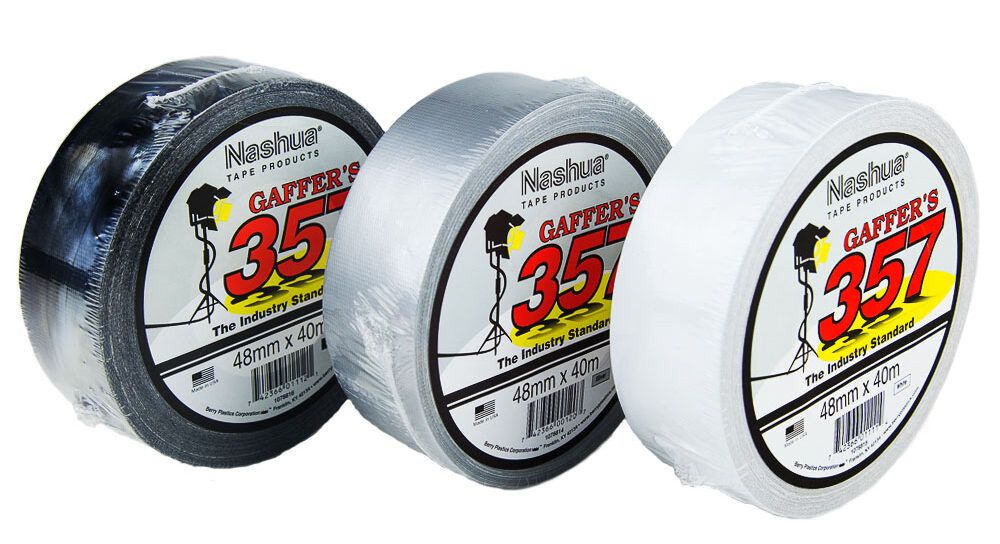
Nashua 357 gaffer tape combines a polyethylene-coated cloth backing with an aggressive natural rubber adhesive. The cloth provides reinforcement and a straight hand tear, while the backing resists abrasion and moisture. Its high initial tack helps it grip a variety of compatible surfaces, including some with a rough texture. [1]
For production teams, that makes 357 a useful candidate for cable holding, bundling, temporary repairs and securing protective materials where the underlying surface can tolerate the adhesive. White and silver also provide options when identification or visibility matters. Stanmart lists 48 mm × 40 m rolls in black, silver and white, individually and in cartons of 24.
Nashua’s manufacturer sheet gives typical values of 0.33 mm thickness, 10.39 N/cm adhesion to steel and 87.56 N/cm tensile strength. Its operating temperature range is 4°C to 93°C. These are laboratory reference values, not a load rating for suspending equipment or a promise of adhesion on every floor.
Although the Australian technical sheet describes clean removal from most surfaces, that is conditional. An adhesive that grips well can still lift a weak coating, leave residue after prolonged contact or affect an incompatible finish.
Shurtape PC 657 from Tenacious Tapes
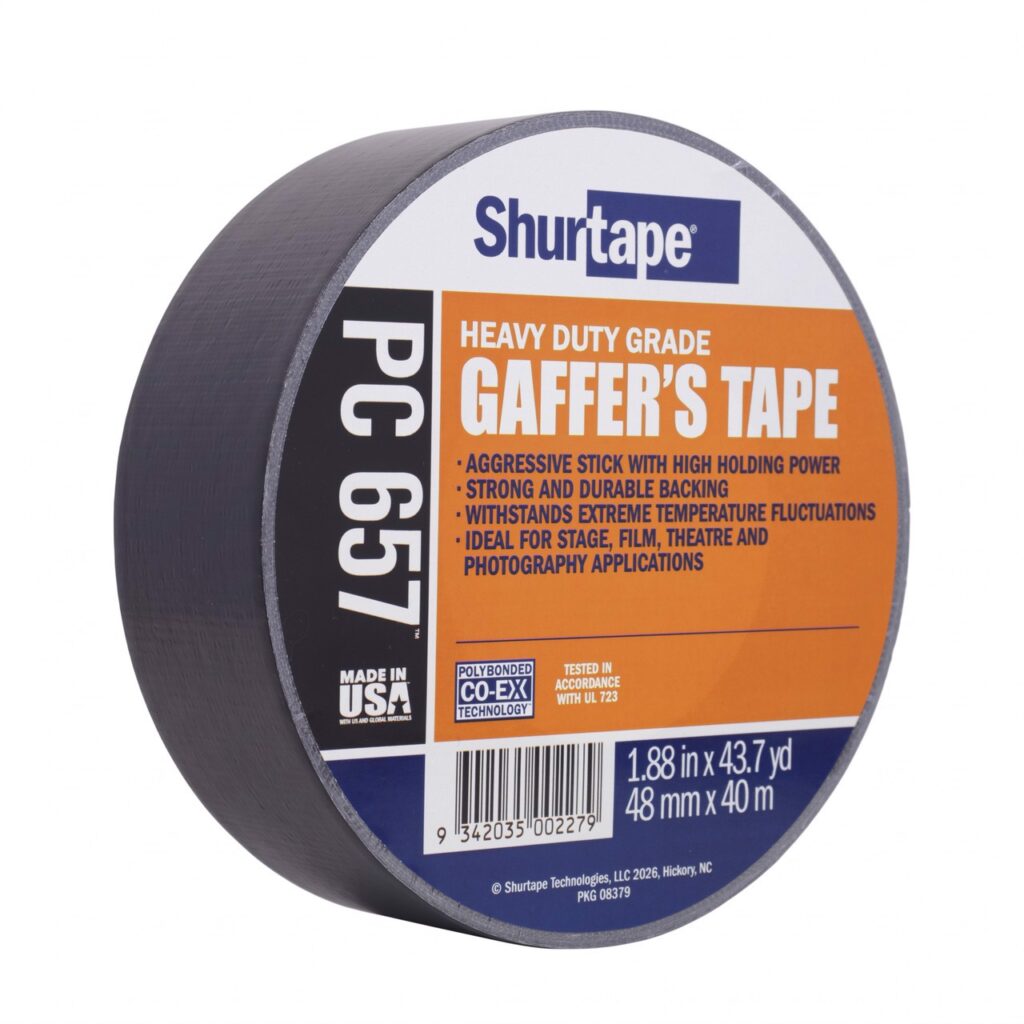
Tenacious describes Shurtape PC 657 as a polyethylene co-extruded cloth tape with a high coat weight of natural rubber adhesive. Its Australian launch information lists a black 48 mm × 40 m roll, 0.37 mm gauge and a service temperature range of 5°C to 90°C.
The stated benefits are easy unwinding, tearing by hand in both directions and an adhesive layer designed to make good contact with complex surfaces. Tenacious identifies cable holding for audio, lighting and staging as a key application. It also reports good resistance to plasticiser migration for cable use. [2]
That last point is relevant to flexible PVC. Plasticisers help keep PVC flexible, but migration into a susceptible adhesive can change the bond and contribute to staining or adhesive softening. Tenacious’s claim makes PC 657 worth assessing for cable work; it does not establish compatibility with every cable jacket or dance vinyl. [4]
Tenacious also says PC 657 was designed for permanent applications while offering good clean-removal qualities. Treat it as a strong-holding tape with removal performance to test on your actual surface. It should not be selected as a low-tack tape for delicate paint.
Nashua 357 and PC 657 compared
| Published detail | Nashua 357 | PC 657 Australian launch |
|---|---|---|
| Backing | PE-coated cloth | PE co-extruded cloth |
| Adhesive | Natural rubber | Natural rubber, high coat weight |
| Thickness | 0.33 mm | 0.37 mm |
| Temperature range | 4°C to 93°C operating | 5°C to 90°C service |
| Local roll format | 48 mm × 40 m at Stanmart | 48 mm × 40 m from Tenacious |
| Colours covered here | Black, silver and white | Black |
| Handling | Hand tearable | Easy unwind; hand tearable both ways |
| Removal claim | Clean removal from most surfaces, subject to suitability | Clean-removal qualities despite permanent-use design |
Sources: Nashua 357 manufacturer TDS dated 20 November 2017, corroborated by Stylus’s February 2022 Australian sheet; Stanmart’s local Nashua listing; Tenacious’s October 2026 launch information and product page. These are published typical values, not results of a Stanmart comparative test. [1] [2]
A note on PC 657 specifications: international listings under the PC 657 name show different thicknesses, roll lengths and temperature figures. The table uses Tenacious’s Australian launch information consistently. For specification-sensitive work, obtain the current sheet for the exact product being supplied. [5]
PC 657’s higher published gauge in this comparison does not, by itself, prove greater holding power or cleaner removal. A fair strength comparison would need matching test methods and confirmed data for both supplied products.


Nashua 357 Tape 2″ (48mm × 40m)
How to read a tape data sheet
Four properties answer different questions.
Tack describes the initial grab.
Peel adhesion measures resistance to being peeled from a specified test surface.
Cohesion is the adhesive’s internal strength.
Tensile strength describes the tape’s resistance to being pulled apart.
A high result in one category cannot stand in for the others. [4]
For a stage crew, this means a tape can feel extremely sticky yet still be unsuitable for a delicate coating. Equally, a strong cloth backing says little about how safely the adhesive will release from a painted floor.
Check the distinction between application temperature and service temperature, too. The latter describes conditions after application; it does not mean tape will bond properly when first applied to a surface at either temperature extreme. Cold surfaces, condensation and dirt can prevent adequate contact. [4]
Choosing tape for cables on sets and stages
Start with the cable route. Keep leads away from pedestrian paths wherever practicable. Where a crossing is unavoidable, assess whether a suitable cable ramp or cover is required, particularly for public access, trolley traffic or larger bundles. SafeWork NSW specifically identifies cable protection ramps and covers as controls where applicable. [6]
For a suitable low-profile cable run, select tape that adheres to both the floor and the cable jacket. Leave enough contact area either side of the cable, press the tape into the surface contours and inspect for raised edges. A strip stretched tightly across a bundle can leave gaps underneath and an edge that catches shoes.
Check the run during use and after scenery or equipment moves. Tape should not conceal damaged cable insulation, carry suspended equipment or replace proper rigging. Remove damaged electrical leads from service. [6]
Our practical recommendation is to trial both the hold and the removal before committing to a long run. Include the expected time on the surface and the working conditions in that trial.
Black tape and glare under production lighting
Black colour and a matte finish are separate properties. Black tape can still catch hard sidelight or show up in a close camera angle. Neither “gaffer” in the name nor a black roll is enough to establish that it will disappear on set. The P743 matte photo tape is probably the best aid to blocking out the light.
When reflections matter, look at a tape specifically sold for its matte finish, such as Nashua 510 Matte Gaffer Tape or Tenacious K969 Super Matte Gaffer. Test a sample under the actual lighting and camera angle. Adhesive suitability still needs a separate check.
Using tape on painted stages and dance floors
Paint lifting and adhesive residue are different problems. Residue remains when adhesive transfers to the surface. Paint lifting occurs when removal pulls away part of the coating system. Tape can leave no adhesive behind and still remove paint.
On painted stages, start with the coating manufacturer’s care instructions and an appropriately low-tack product. Rosco recommends testing, allowing paint to cure completely and avoiding excessive burnishing onto painted finishes. A quick test immediately after application will not represent several days of use. [7]
For JuJu Blitz painted floors, STM’s May 2024 application methodology recommends heritage or exhibition quality low-tack tapes and a trial in an inconspicuous area. Its Weathertex re-coat guidance notes that a floor may be usable after 24 hours in normal conditions while full cure can take up to two weeks. Walk-on readiness does not establish readiness for aggressive tape.
Tenacious K740 Heritage Delicate Flowmask is one lower-tack option to assess for suitable delicate surfaces. It is not a universal damage-prevention barrier, and adding stronger tape over a low-tack layer does not automatically secure a cable installation. [8]
For dance vinyl seams, use the tape specified or approved for that flooring and installation method. PC 657’s reported plasticiser resistance for cables should not be extended into a blanket dance-floor recommendation. Footwear, cleaning methods, seam profile and removal requirements all matter.
Applying and removing gaffa tape
- Identify the surface. Record the coating or flooring type, its condition, the tape code and the intended duration. Check the venue’s requirements before applying tape.
- Prepare it appropriately. Remove loose dirt and use only a cleaner suitable for the surface. Allow it to dry fully. Do not assume a solvent that cleans metal is suitable for paint or vinyl.
- Test the complete job. Use the proposed tape on a discreet representative area. Leave it for a realistic period, then inspect the surface and the removed tape.
- Apply with controlled pressure. Obtain full contact without stretching the tape tight. On painted surfaces, avoid excessive rubbing or burnishing.
- Monitor and remove promptly. Manage lifting edges during use, and remove the tape once the job is finished. Keep the peel slow and close to the surface. Stop if the coating starts to lift. [7]
If adhesive remains, check with the surface supplier before using a remover. Test the proposed cleaner separately. Solvents, scraping and heat can alter a finish even when they remove the adhesive successfully. Follow the floor’s care instructions and restore a clean, dry surface before use.
Keep unused rolls in their original packaging in a cool, dry place away from direct sun. For stock rotation, follow the shelf-life guidance for the specific product and supplier; no single shelf life applies to all gaffer tape. [5]
Other tapes worth keeping in the kit
A small selection covers more jobs than one aggressive tape used everywhere. Stanmart’s washi paper spike tapes provide options for temporary position marks. Our wider tape and adhesive range also includes matte cloth, photographic masking, dance-floor and double-sided products from brands including Tenacious, Nashua, Nitto and Permacel. Choose each by its intended application and surface compatibility.
Common questions about gaffa tape
Is Nashua 357 the same as a matte gaffer tape?
Nashua 357 is a PE-coated cloth tape with strong natural rubber adhesive. For a task where a specified matte finish is essential, assess a dedicated matte product such as Nashua 510 and check it under the working lights.
Is Shurtape PC 657 better than Nashua 357?
There is no universal winner. Both are strong-holding cloth tapes. PC 657’s Australian launch highlights handling and plasticiser resistance for cables; Nashua 357 has published Australian technical data and several local colour options. The deciding test is the actual surface, duration and removal result.
Will gaffer tape remove paint?
Yes, and Nashua 357 in particular can be aggressive enough to lift stage paint when removed. Just because a painted surface appears fully dry, or a tape is described as clean-removing, doesn’t mean the coating won’t be damaged.
Proper surface preparation and priming are essential to achieving good paint adhesion and reducing the risk of damage during tape removal. A good example is our Weathertex Primer and JuJu Blitz stage paint system, where correct preparation and application help produce a more durable finish.
For more delicate surfaces, we also supply specialist low-tack, exhibition-grade tapes from Heritage, designed for applications where surface protection is a priority.
Always follow the paint manufacturer’s preparation and curing instructions, select a tape suitable for the surface and intended application, and test it in an inconspicuous area before widespread use.
Can gaffa tape be used outdoors?
Suitability depends on the product, surface, weather and duration. A moisture-resistant or waterproof backing does not mean the entire taped joint is waterproof, suitable for immersion, or reliable under prolonged UV exposure. Seek a product recommendation for the actual conditions.
Gaffa tape advice and supplies in Sydney?
Stanmart Film Services supplies production consumables from Unit 3, 33 Lower Gibbes Street, Chatswood NSW 2067, supporting film, television, theatre and event work as part of the Monart Group.
Browse Nashua 357 or ask Stanmart about PC 657 availability and the best tape for your application. Tell us the surface, whether it is painted or coated, how long the tape will stay down and whether it will be visible on camera. Call 02 9417 3000.
Technical sources
Product details checked 25 October 2026. Supplier specifications may change. This article’s recommendations are based on the cited product information and surface-care guidance, not a laboratory comparison by Stanmart.
- Stylus Tapes International, Nashua 357 technical data, February 2022. Cross-checked against Berry Global’s Nashua 357 TDS dated 20 November 2017.
- Tenacious Tapes, Shurtape US Gaffer PC657, together with its October 2026 Australian launch information.
- Shurtape Tape University, duct tape and gaffer’s tape. General category guidance; individual product sheets take precedence.
- Tenacious Tapes, Adhesive Tapes Glossary. Adhesion, cohesion, plasticiser resistance and application temperature.
- Shurtape, PC 657 Duck Pro US product information. International reference; figures differ from the Australian launch information.
- SafeWork NSW, Electrical risks at the workplace. Cable routing, protection and damaged leads.
- Rosco, How to Gently Remove Tape from Painted Surfaces. Also consulted: STM Studio Supplies, JuJu Blitz Application Methodology, May 2024, page 6.
- Tenacious Tapes, K740 Heritage Delicate Flowmask.